Prediction Markets 101

Intro to Prediction Markets
The popularity of prediction markets continues to rise in the US, from popular apps like Kalshi and Polymarket to more sports-specific prediction markets from reputable brands like FanDuel Predicts and Fanatics Markets.
If you're new to prediction markets and want a quick overview — especially if you're interested in making trades on sporting events and futures — you've come to the right place. On this page, we'll give you a brief overview of what prediction markets are, how to use them, and how to make predictions on sports and more for a chance to win real cash prizes.
Prediction markets have clearly entered the mainstream in the US, aided in part by ongoing oversight from regulators like the CFTC that has allowed these exchanges to operate across state lines. At their core, prediction markets let users take positions on the likelihood of real-world events, ranging from financial indicators and economic data to entertainment, sports, politics, and beyond.
That wide scope has also sparked debate, as some markets touch on sensitive or controversial topics. At Sportsbooks Online, our primary interest is how these platforms apply to sports. From that perspective, prediction markets can function as an alternative to traditional betting, offering a more market-driven approach where pricing is shaped by users rather than set by oddsmakers, and without the typical built-in house edge.


Understanding Prediction Markets
To understand prediction markets, it helps to think in terms of contracts rather than bets. Each market revolves around a clearly defined question with two possible outcomes: yes or no. Each outcome is represented by a contract priced between $0 and $1. That price reflects the market’s current belief about probability. A contract trading at $0.30 implies a 30% chance of occurring, while one at $0.80 implies an 80% likelihood. If you believe the market is underestimating an outcome, you can buy shares. If you think it's overvalued, you can sell it.
When the event concludes, the contract settles at either $1 if you win, or $0 if your pick loses. Your profit comes from the difference between what you paid and the final value, or from trading out of your position before resolution at a better price. This is where prediction markets diverge sharply from many betting apps: If you buy a contract at $0.40 and it rises to $0.70 as sentiment shifts, you can sell early and lock in profit before the final buzzer. This simulates the experience of cashing out early on a betting app, which you don't always have the option to do.

NHL on Underdog Predict

Fanatics Markets homepage

CBB on DraftKings Predictions
Using Strategy on Prediction Markets
This flexibility opens up a range of strategies. Some traders focus on long-term positions, similar to futures bets in sports betting. Others specialize in short-term swings, reacting to breaking news, injuries, or momentum shifts. The ability to trade in and out makes timing just as important as being right.
Another major distinction is pricing. In sportsbooks, odds are carefully engineered to balance action and protect the house. In prediction markets, pricing is entirely market-driven. It reflects the aggregated beliefs of all participants, from casual users to highly informed traders. This leads to both opportunities and risks: On one hand, the absence of a built-in house edge means you're not automatically fighting against a margin. On the other hand, markets can be inefficient — especially in less popular categories — creating both value and volatility.
The Difference Between Prediction Markets
It's also worth noting that not all prediction markets operate the same way. Some are fully regulated exchanges overseen by US authorities, while others operate in decentralized or offshore environments. Differences can include fee structures, liquidity, available markets, and user protections. For most users, regulated platforms offer a more stable and transparent experience.
At their core, prediction markets reward information, timing, and discipline. The more accurately you can assess probability and identify when the market is wrong, the better your chances of making money.
Using Prediction Markets for Sports Predictions
For sports-focused users, prediction markets offer a compelling alternative to traditional betting — especially if you think like a trader rather than a bettor.
The biggest advantage is pricing.
In a sportsbook, odds are shaped by bookmakers and influenced by sharp money, with a built-in margin ensuring the house always has an edge. On prediction markets, prices are determined entirely by supply and demand. There's no "vig" or fee baked into the contract itself (Most prediction markets do, however, charge a nominal fee per trade), which means the pricing is often more efficient and sometimes more exploitable.
Instead of betting at -110 and paying a hidden tax on every wager, you're buying into a probability. If you think a team has a 60% chance to win a title and the market is pricing it at 45%, that's a clear value opportunity. You're not just picking winners, you're identifying mispriced probabilities.

Snapshot of the DraftKings Predictions web interface
Another major benefit is flexibility.
In sports betting, once your bet is placed, you're largely stuck unless cash-out options are available (and those often come with a cost). In prediction markets, every position is tradable. You can enter early in the season, ride price movements, and exit before the outcome is decided.
This is especially useful for futures-style sports trades. If you purchase a contract on a team to make the playoffs at $0.25 early in the season, for example, you can sell for a profit if that team starts strong and the price rises to $0.60 without needing them to actually clinch a playoff spot. In a way, you've effectively traded the narrative rather than the final result.
Prediction markets also shine when it comes to transparency.
You can see how prices move, how much volume is being traded, and how sentiment shifts over time. That level of visibility is rarely available in sportsbooks, where odds changes can feel opaque.
There's also a strategic edge in the concept of “fading the public.” Because prices are driven by user behavior, heavily one-sided markets can create opportunities for contrarian trades. If casual users pile into a popular team or storyline, prices may drift away from true probability, opening the door for sharper traders to take the other side.
Perhaps most importantly, prediction markets don't limit or penalize winning users. In the sportsbook world, consistent winners can face reduced limits or account restrictions. In a peer-to-peer market, profitable traders are simply part of the ecosystem.
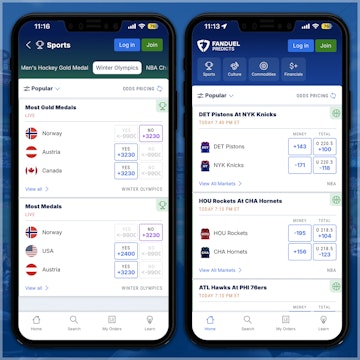
Sports prediction features on FanDuel Predicts
Prediction markets are not, however, a perfect replacement for sportsbooks.
They typically offer fewer betting options on markets like point spreads, same-game parlays, and deeper player props. Instead, they focus on broader outcomes like game winners, season milestones, and awards.
But for traders who value efficiency, flexibility, and the ability to act on evolving information, prediction markets provide a uniquely powerful way to engage with sports. They reward those who can consider probabilities and move quickly when the market gets it wrong.
Yes! Prediction markets are safe and legal to use in the US, but only under specific conditions. They must operate as regulated financial exchanges overseen by the Commodity Futures Trading Commission (CFTC), which treats them as event-based derivatives rather than gambling products.
Because of this classification, federally approved platforms can offer markets nationwide, even in states where traditional sports betting is not legal. However, not all platforms meet these standards. Some offshore or decentralized markets operate outside US regulations and may not be legal for American users. For safety and compliance, it's important to stick with CFTC-regulated prediction market platforms.
Non-Sports Markets Available on Prediction Markets
While sports are a natural entry point, prediction markets extend far beyond the field. In fact, non-sports categories often make up the majority of available markets, and they're part of what makes these platforms so unique.
Users can trade on political outcomes, economic indicators, entertainment awards, and even weather events. Markets might center on election results, interest rate decisions, box office performance, or whether a major product release gets delayed. If an event has a clear, measurable outcome, it can usually be turned into a tradable contract.
Common Non-Sports Categories on Prediction Markets
- Politics
- Economy & finance
- Entertainment & awards
- Weather & climate
- Business & corporate events
- Technology & product releases
- Public health & science
These markets can be appealing because they draw on different types of knowledge. Political junkies, financial analysts, and pop culture enthusiasts all have opportunities to leverage their expertise. In some cases, these markets are more difficult to parse than than sports, creating more room for sharp traders to find value.
However, non-sports markets are also the most controversial. Because they often involve real-world events with broader societal impact, concerns about insider information and ethical boundaries come into play. For example, markets tied to political decisions or economic policy can raise questions about who has access to privileged information and whether that creates an uneven playing field.
There are also markets that feel inherently uncomfortable or even dystopian, such as those speculating on geopolitical instability or leadership changes. While they may provide insight into public sentiment, they blur the line between forecasting and profiting from serious, even catastrophic real-world events.
For that reason, many users approach non-sports markets with a mix of curiosity and caution. They expand the scope of what prediction markets can do, but they also highlight the ethical complexities of turning real-world outcomes into financial instruments.


Frequently Asked Questions About Prediction Markets
At their core, prediction markets let users take positions on the likelihood of real-world events, ranging from financial indicators and economic data to entertainment, politics, and beyond.
Prediction market bonuses are trade matches and bonus offers featured on prediction markets. At this time, it's rare for a prediction market to offer daily bonuses like a sportsbook does; however, most prediction markets for sports trading do offer sign-up bonuses for new users.
Yes! Every prediction market featured on this page has a welcome offer for new users.
Check this list of all prediction markets for our full list of the top prediction markets for betting on sports. On that list, you'll find Underdog Predicts at the top, ranking #1 among prediction markets that offer sports trades in the US.
Mark is a lifelong sports fan who inherited rooting interests in the St. Louis Cardinals and Pittsburgh Steelers. After a decade in sports media covering sports betting as a writer, editor and producer, Mark brought his long track record of sports experience to the Sportsbooks Online team in early 2025.